

12,000+ Dutch companies are recognised IND sponsors. Half of them is barely using it.
If your company is one of them, or is considering becoming one, here is what you should know about what recognised sponsorship actually makes possible for your business and your team.
For many companies, the journey to recognised IND sponsorship starts with a single hire. There is a candidate who is exactly right for the role, and they happen to be from outside the EU. Someone investigates what it takes, the application goes in, the status is granted, and the hire is made.
What happens next is where most companies get it wrong, not through carelessness, but through a gap between what they think they signed up for and what recognised sponsorship actually requires.
The numbers behind the scheme
The scale of recognised sponsorship in the Netherlands is larger than most people realize, and it is growing.
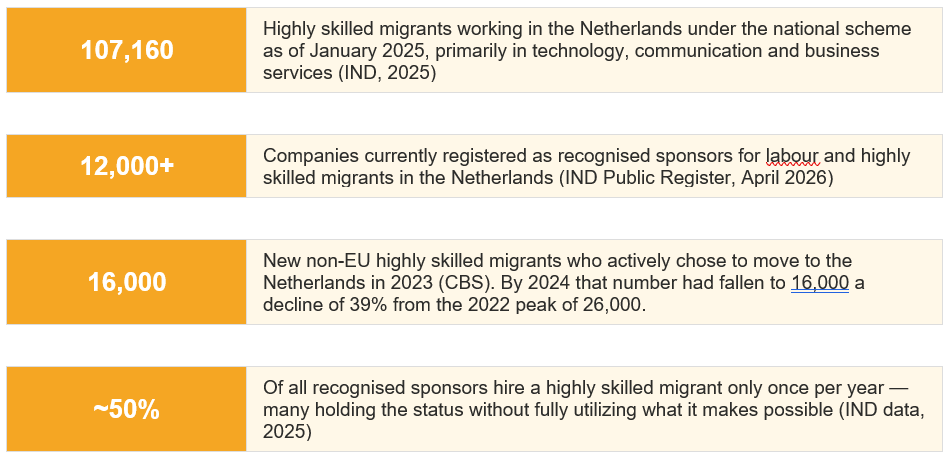
These are not abstract figures. They represent a competitive infrastructure that the most internationally oriented Dutch companies are already using and that thousands more are underutilizing. And with new non-EU arrivals declining, the case for using recognised sponsorship strategically, rather than reactively, has never been stronger.
What recognised sponsor status actually means
The IND grants recognised sponsor status to employers who meet specific criteria around financial stability, compliance history, and organizational structure. Once granted, it allows you to hire non-EU nationals under the Highly Skilled Migrant scheme, the EU Blue Card, and the Intra-Company Transfer permit.
The practical benefit is significant. Visa processing for recognised sponsors runs two to four weeks. For non-recognised sponsors, the same process takes eight to twelve weeks. In competitive international hiring situations, that speed is not a minor convenience. It is the difference between landing the hire and losing them to another offer.
There is also a signal value that is easy to underestimate. When an international candidate sees that your company is a recognised IND sponsor, it tells them something meaningful - that your organization has been vetted, that the infrastructure for their arrival exists, and that you have done this before. For professionals weighing up offers across multiple European countries, that matters.
The governmental application fee is €5,080, with a reduced rate of €2,539 for companies that have existed for less than 1.5 years or have fewer than 50 employees globally. For the access it provides to the full international talent market, it is one of the most cost-effective investments a growing Dutch company can make.
Which companies benefit most
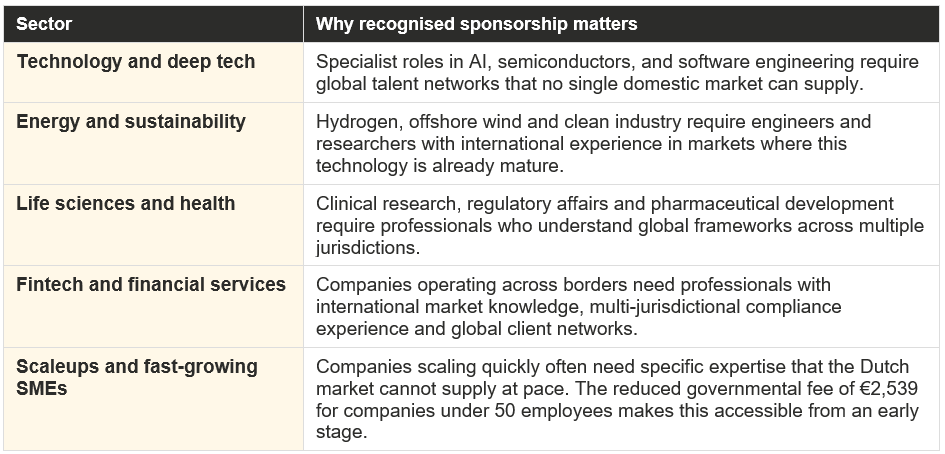
Recognised sponsorship is relevant across sectors, but it is particularly powerful for companies in knowledge-intensive industries where specialist talent is globally distributed and domestic supply is limited.
Three obligations every recognised sponsor must stay on top of
This is where many companies find themselves underprepared. Not because they are careless, but because HR teams are under significant pressure and immigration compliance sits alongside dozens of other priorities.
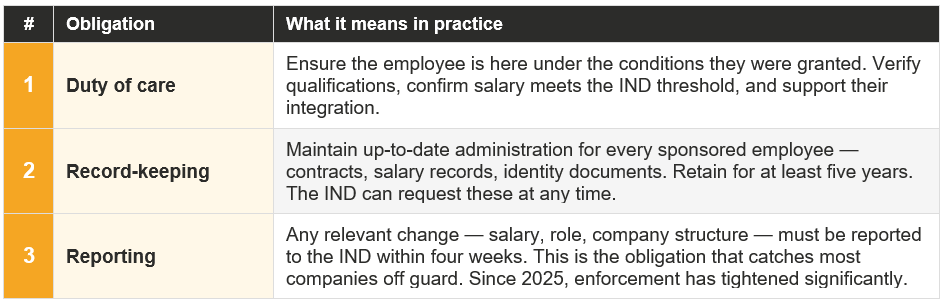
Missing the four-week reporting window, even unintentionally, puts you in breach. In serious cases the IND can revoke your recognised sponsor status - and the residence permits of every employee you sponsor are directly at risk.
This is an HR challenge as much as a compliance challenge
The companies that manage recognised sponsorship well are not necessarily the ones with the largest legal teams. They are the ones that have made someone specifically responsible for it and given that person the tools, the training, and the internal authority to keep everyone aligned.
In practice this means a clear internal process for flagging changes that might trigger a reporting obligation. Calendar reminders for permit expiry dates. A direct line between HR and your immigration advisor. And line managers who understand their role in surfacing relevant changes in time.
This is the gatekeeper function that makes the difference - not a legal review once a year, but an embedded process that keeps compliance live and visible as the organization changes around it.
The bigger picture - what recognised sponsorship makes possible
Done well, recognised sponsor status is one of the most powerful tools a growing Dutch company has access to. It opens the full global talent pool - not just EU nationals, not just candidates who happen to have existing Dutch work authorization, but the full international market.
It also creates a genuine two-way commitment that the best international candidates actively look for. When your company sponsors someone’s move to the Netherlands, you are investing in their future here. They, in turn, bring knowledge, perspective, networks, and capabilities that the domestic talent market alone cannot replicate.
The companies getting this right are not just staying compliant. They are building the internationally oriented teams that define the most competitive Dutch businesses right now - and that will carry them through the next decade of innovation.
Is recognised sponsorship right for your company?
If your company is in technology, life sciences, energy, fintech, engineering, or any knowledge-intensive sector where specialist talent is globally distributed, the answer is almost certainly yes.
The 12,000+ companies already registered represent a fraction of the Dutch business community. The question is not whether international talent exists. It is whether your company has the infrastructure to access it.
At Rehive People, recognised sponsorship support is a core part of what we do, not just the application, but the ongoing process that keeps you compliant and makes the most of the status you have worked to achieve. If your company is considering recognised sponsor status, has recently obtained it, or is not entirely sure whether your current process is as robust as it needs to be, that is the conversation we should be having.
So… is your company making the most of it?