

Internationals in the Netherlands, the numbers tell more
Thank you for your interest in this article. What follows is a fuller picture of what the data shows, why I think it matters, and what I believe needs to change, both at a policy level and in the way Dutch employers approach international hiring.
The trend nobody is talking about loudly enough
The Netherlands was built on openness. Centuries of trade, migration, and international exchange shaped a country that became one of the most internationally connected economies in the world. That legacy did not happen by accident. It happened because the Netherlands actively chose to be a destination — for commerce, for knowledge, for talent.
That is what makes the current trend so striking. For most of the past two decades, the number of non-EU highly skilled migrants choosing the Netherlands grew consistently. The only exception was 2020, when COVID-19 made movement impossible. What followed in 2021 and 2022 was a strong recovery. But since the 2022 peak, the direction has reversed ,and the decline is accelerating.
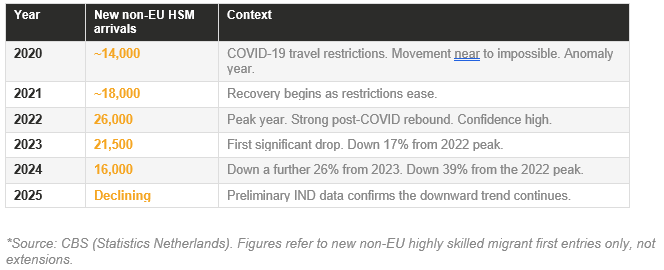
These are people who made an active decision to move here. Meaning extensions are excluded, solely new arrivals. This becomes a trend; fewer internationals are choosing the Netherlands every single year.
What is driving this
Several factors are converging, and it is important to separate them.
The first is political climate. The public debate around migration in the Netherlands has become louder and more complicated. That signal reaches international professionals long before they speak to a Dutch employer. When a country’s public discourse questions whether internationals are welcome, talent notices. And talent has options.
The second is financial incentive erosion. The 30% ruling, one of the Netherlands’ most effective tools for attracting highly skilled migrants, has been reduced from 30% to 27% for post-2024 contracts, and its long-term stability is no longer guaranteed. When a candidate is weighing offers across Europe, that uncertainty matters.
The third, and most significant, is competitive pressure. The Netherlands did not become less attractive in isolation. It became relatively less attractive because other countries are actively redesigning their systems to win this race.
Portugal’s IFICI regime offers qualified professionals a flat 20% income tax rate for ten consecutive years. Spain’s talent visa and digital nomad framework have been substantially upgraded. Germany has introduced an 18-month post-graduation residence permit and doubled international student work hours, specifically targeting graduates at the moment they are deciding where to build their careers. These countries are not managing migration. They are strategically competing for it.
The Netherlands built one of the fastest and most employer-friendly immigration systems in Europe. The Highly Skilled Migrant visa processes in two to four weeks for recognised sponsors is a genuine advantage. But processing speed alone is not enough when the broader environment is sending a conflicting signal.
Why this matters more than most people realise
The sectors most dependent on non-EU specialist talent are precisely the sectors where the Netherlands leads.
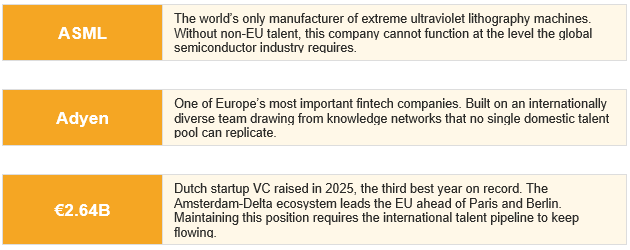
When fewer international professionals choose the Netherlands, it is not just a demographic statistic. It is a direct constraint on the innovation capacity of the most strategically important sectors in the Dutch economy. Semiconductors, deeptech, energy technology, fintech and medtech, these are not industries where you substitute global expertise with local alternatives. You either have the talent or you fall behind.
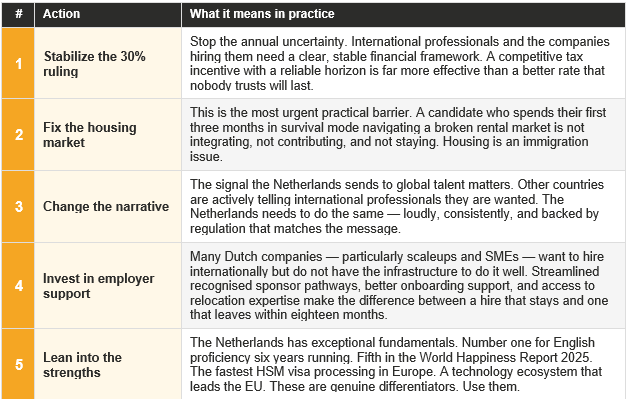
What we believe should to change
We work with international talent and the employers who hire them frequently. From that position, I see both sides of this challenge clearly. Here is my perspective on what needs to happen.
A final thought
The Netherlands did not become one of the most internationally connected economies in the world by accident. It got here because it was open, well-organized, and genuinely welcoming to people who wanted to contribute to it.
That foundation has not disappeared. But it requires active stewardship. The countries competing for the same talent are not waiting for the Netherlands to find its confidence again. They are moving now, with clear strategies and strong signals.
At Rehive People, this is the conversation we are having with employers every week. The ones who understand the urgency are building teams that will define the next decade of Dutch innovation. The ones who are not yet paying attention will feel the gap before they see it.
The competition is not waiting. Let’s pace up.